Navratri 2026: Dates, Ghatasthapana Muhurat, Nine Forms of Durga & Kanya Pujan Guide
Hindu Rituals · Updated 6 October 2026 · 6 min read
Sharad Navratri 2026 begins on Sunday, 11 October and ends on Monday, 19 October. It opens with Ghatasthapana (Kalash Sthapana) on Pratipada. Durga Ashtami and Maha Navami both fall on 19 October this year, and Vijayadashami (Dussehra) is on Tuesday, 20 October 2026.
Navratri — "nine nights" — is the most important festival of Shakti worship. Over nine days devotees worship the nine forms of Maa Durga, recite the Durga Saptashati, keep fasts and close the festival with Kanya Pujan. This guide covers the 2026 dates, the muhurat, the step-by-step Kalash Sthapana, the meaning of each form of the Goddess, and how families abroad can observe Navratri properly.
Navratri 2026 key dates
| Observance | Date | Day |
|---|---|---|
| Ghatasthapana (Kalash Sthapana), Pratipada | 11 October 2026 | Sunday |
| Durga Ashtami | 19 October 2026 | Monday |
| Maha Navami | 19 October 2026 | Monday |
| Vijayadashami (Dussehra) | 20 October 2026 | Tuesday |
Because two tithis overlap this year, Ashtami and Navami are observed on the same day, 19 October. If your family does Kanya Pujan on Ashtami or on Navami, both fall on 19 October in 2026.
Ghatasthapana muhurat 2026
Panchangs list the main Ghatasthapana muhurat on 11 October as about 6:19 AM to 10:12 AM IST, with the Abhijit Muhurat around 11:44 AM to 12:31 PM IST as a second window. Exact minutes change with your city, because the muhurat is calculated from local sunrise and the Pratipada tithi. If you live outside India, use a panchang set to your city rather than converting IST times.
The nine forms of Maa Durga (Navadurga)
The nine forms worshipped through Navratri are named in the Devi Kavacham, recited as part of the Durga Saptashati ("Prathamam Shailaputri cha, dvitiyam Brahmacharini…"). One form is worshipped on each day, in this order:
- Shailaputri — daughter of the Himalaya (Himavan); the first form, worshipped at Ghatasthapana.
- Brahmacharini — the Goddess in penance, symbol of discipline and devotion.
- Chandraghanta — adorned with a half-moon shaped like a bell; brings courage and peace.
- Kushmanda — believed to have created the universe with her smile.
- Skandamata — mother of Skanda (Kartikeya), shown with the child on her lap.
- Katyayani — born in the ashram of sage Katyayana; the warrior form who defeats Mahishasura.
- Kalaratri — the fierce dark form who destroys ignorance and fear.
- Mahagauri — radiant and pure; worshipped on Ashtami.
- Siddhidatri — the giver of siddhis (spiritual accomplishments); worshipped on Navami.
How to do Kalash Sthapana at home
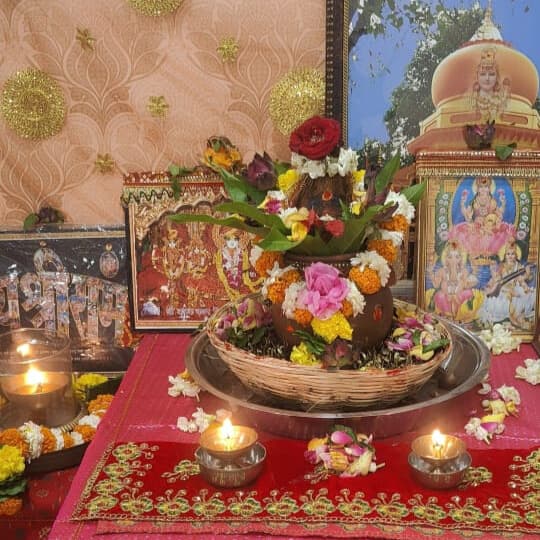
Ghatasthapana invokes the Goddess into a sacred pot (kalash) that stays in the home for all nine days.
Samagri: a copper, brass or clay kalash; Ganga jal or clean water; a coconut with husk; five mango (or ashoka) leaves; red cloth or chunri; mauli (sacred thread); roli, haldi, akshat (unbroken rice); supari and a coin; clean soil and barley (jau) seeds in a shallow clay tray; a wooden chowki; flowers, dhoop, a ghee diya; a picture or idol of Maa Durga; fruits and sweets for bhog.
Steps:
- Clean the puja area and set up the chowki with a red cloth, ideally facing east or north.
- Spread soil in the clay tray and sow the barley seeds. The sprouts (jaware or khetri) grow through Navratri and are a sign of prosperity.
- Fill the kalash with water and add supari, a coin, akshat and a little Ganga jal. Draw a swastika on it with roli and tie mauli around the neck.
- Arrange the mango leaves around the mouth of the kalash and place the coconut, wrapped in red cloth and tied with mauli, on top. Set the kalash on (or beside) the barley tray.
- Worship Lord Ganesha first, then invoke Varuna in the kalash and then Maa Durga.
- Take the sankalp: holding water, akshat and flowers, state your name, gotra, place and the intention for which you are keeping Navratri.
- Light a ghee diya. Many families keep an akhand jyoti burning for all nine days — only do this if you can keep it safe.
- Each day: puja of the day's form of Durga, recitation of the Durga Saptashati or Durga Chalisa, aarti and bhog.
The Durga Saptashati
The Durga Saptashati (also called Devi Mahatmya or Chandi Path) is 700 verses in 13 chapters, part of the Markandeya Purana. It is arranged in three parts: the first tells of Mahakali and the demons Madhu and Kaitabha; the middle part of Mahalakshmi and the defeat of Mahishasura; the last of Mahasaraswati and the destruction of Shumbha and Nishumbha. Families who cannot read the full text daily often read one or two chapters each day, so that the whole Saptashati is completed by Navami.
Kanya Pujan on 19 October 2026
Kanya Pujan honours young girls as living forms of the Goddess, and is done on Ashtami or Navami — both on 19 October this year.
- Invite nine girls (traditionally aged about 2 to 10) and, in many North Indian homes, one boy as Langur or Batuk Bhairav.
- Wash their feet, seat them on a clean mat and apply kumkum tilak and akshat. Tie mauli on their wrists.
- Serve the traditional prasad of halwa, puri and kala chana.
- Offer small gifts — bangles, chunri, stationery or dakshina — and touch their feet to receive blessings.
Vijayadashami: 20 October 2026
On Dussehra the kalash is respectfully moved (visarjan) and the barley sprouts are shared as blessings. It marks Lord Rama's victory over Ravana and Maa Durga's victory over Mahishasura. Bengali families perform Durga idol visarjan, and in Maharashtra people exchange Apta (Shami) leaves as "gold".
Navratri fasting rules
- Many devotees keep a full nine-day fast; others fast on the first and last days, or on Ashtami.
- Allowed foods: fruits, milk and curd, nuts, sabudana, kuttu and singhara flour, rajgira, potatoes and sweet potatoes, with sendha namak (rock salt).
- Avoided: grains, lentils, regular salt, onion, garlic, alcohol and non-vegetarian food.
- Elderly people, pregnant women and anyone on medication should keep a lighter fast and consult their doctor.
Observing Navratri when you live abroad
- Check dates for your city. Tithis begin and end at fixed moments, but which day a festival falls on depends on local sunrise. In North America the dates usually match India's, but the muhurat times do not.
- Barley sowing works indoors with ordinary potting soil — keep the tray near light and water it lightly each day.
- Mind smoke alarms. An akhand jyoti or dhoop can trigger alarms in apartments. A diya in a glass holder, or a smaller jyoti lit during puja times, is a practical alternative.
- Kanya Pujan with your community. Invite girls from friends' families or your local temple community. Children enjoy it, and it passes the tradition to the next generation.
- Sankalp in India. If your schedule does not allow the full rituals, you can have Kalash Sthapana and Kanya Poojan performed in India in your family's name, or book a Navratri pooja with our pandits.
Navratri ends with Dussehra, and twenty days later comes Diwali — read our guide to Diwali 2026 Lakshmi Puja to plan ahead.
Frequently asked questions
When does Navratri start in 2026?
Sharad Navratri 2026 begins on Sunday, 11 October 2026 with Ghatasthapana (Kalash Sthapana) and ends on Monday, 19 October. Vijayadashami (Dussehra) is on Tuesday, 20 October 2026.
When is Kanya Pujan in Navratri 2026?
In 2026 Durga Ashtami and Maha Navami are both observed on Monday, 19 October, so families who do Kanya Pujan on either Ashtami or Navami will do it on 19 October.
How many girls should be invited for Kanya Pujan?
Traditionally nine girls between about 2 and 10 years old, representing the nine forms of Durga, and in many North Indian families one boy as Langur (Batuk Bhairav). If you cannot invite nine, worship whoever you can with full devotion.
What can I eat during the Navratri fast?
Common vrat foods are fruits, milk and curd, nuts, sabudana, kuttu (buckwheat) and singhara (water chestnut) flour, rajgira, potatoes and sweet potatoes, cooked with sendha namak (rock salt). Grains, lentils, onion and garlic are avoided.
Can I do Ghatasthapana if I live outside India?
Yes. Do the Kalash Sthapana in the morning of Pratipada as per a panchang calculated for your own city, since muhurat times depend on local sunrise. If you cannot do it yourself, you can have it performed in India in your family’s name.
Sources
Dates are cross-checked against published panchangs. Muhurat times are for India (IST) unless stated — check a panchang for your own city.
More guides
Festival
Diwali 2026: Lakshmi Puja Date, Muhurat, Samagri & Step-by-Step Vidhi
Diwali 2026 Lakshmi Puja is on Sunday 8 November. All five Diwali dates, the Pradosh Kaal muhurat, a samagri list and the Lakshmi-Ganesh puja vidhi.
4 min read
Festival
Mahashivratri 2027: Date, Nishita Kaal, Char Prahar Puja & Fasting Rules
Mahashivratri 2027 is on Saturday 6 March. Nishita Kaal timing, the four-prahar night puja, what to offer and avoid, and fasting and parana rules.
3 min read
Festival
Akshaya Tritiya 2027: Date, Significance, Puja Vidhi & What to Buy or Donate
Akshaya Tritiya 2027 is on Saturday 8 May. Tithi timings, the legends behind the day, a simple Vishnu-Lakshmi puja vidhi and what to buy or donate.
3 min read